Article
THE WAIT PAYS OFF
THE WAIT PAYS OFF
PETER CRAWSHAW AND ROBERT HANNAN
Being members of the Australiana Society since 2019 has been an unexpected addition to our busy retirement years. We have been ‘hit with the Australiana bug’, and met and got to know many members who have encyclopaedic knowledge of their research and collecting fields. In 2014 we began to focus on the history of our 1847 house and local area of Glebe, Sydney. This has been both rewarding and informative and we have added to the already extensive research of others.
In the August 2020 issue of Australiana, we wrote an article on the amateur watercolourist, James Coutts Crawford (1817–1889), an Englishman who visited Australia in 1845–46 and rented ‘Forest Lodge’, an early colonial house in Glebe. Later he moved to New Zealand, where he became sheriff of Wellington, dying in London on a visit ‘home’. In Glebe, he painted several local landscape scenes that included some early identifiable buildings as well as some in the country areas he visited. While these watercolours are not of great artistic merit, Coutts Crawford’s views and panoramas record and complement the early colonial history of one of Sydney’s oldest suburbs. The watercolours are important visual information recording the changing landscape as the early colonists cleared land, built houses, established gardens, created horse yards and set aside vegetable plots around the harbour foreshores. In Glebe they initially adapted the bays and foreshores for marine villas with extensive pleasure grounds and views up Port Jackson back to Sydney town. Later foreshore industrialisation from the 1880s changed the landscape even more into a busy working harbour.
In our 2020 article, we reported that while we were the owners of two of the original watercolours, we had only poor black and white photographic copies of six others annotated as ‘The Glebe’ from the State Library of NSW’s collection. We concluded the 2020 article by stating we hoped the elusive original pictures would one day be located – a common lament.
In June this year we received email alerts from some fellow members, who assiduously peruse the auctions across the country, that lot 286 at an upcoming Melbourne auction sale comprised what we had been waiting for. Indeed they were, and we were the successful bidders. This has meant we now have eight early images.
Another reason these watercolours are important is that one includes an image of a demolished house (plate 1) and two of partially demolished houses (plates 2 & 3). The exact location of the remaining three, all of ‘The Glebe’ are yet to be fully identified.
There are many advantages in belonging to our Society. One certainly is the development of friendships and contacts with many others who are willing to share. Over the years the well-researched magazine articles have added much to fostering scholarship in areas, topics and historical figures where there has been limited or unpublished information. The added advantages of sharing knowledge, and being able to see, appreciate and discuss other members’ collections, means that we have been able to add to our own understanding of early colonial development in our vicinity and the place of our own house in its development.
The Australiana Society
secretary@australiana.org.au
Reproduced courtesy Australiana Magazine
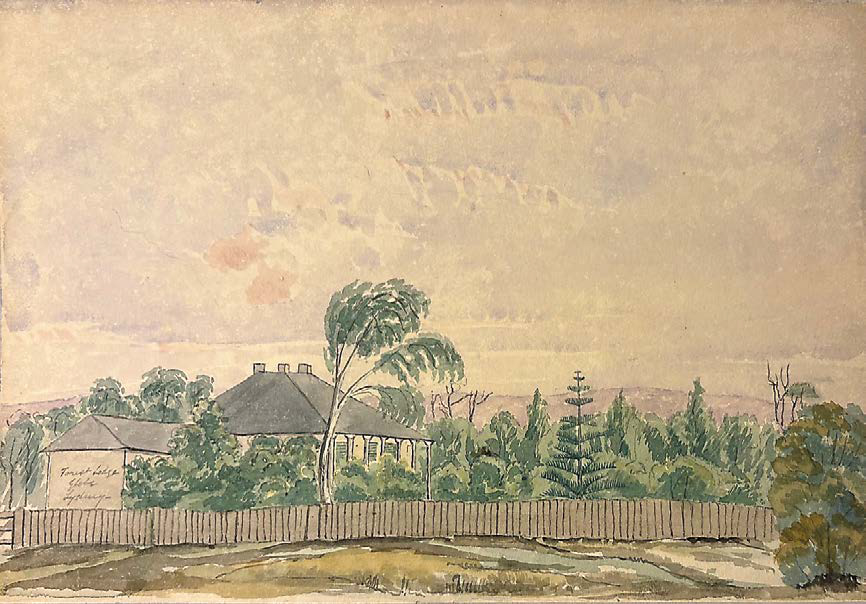
1. James Coutts Crawford (1817–1889), Forest Lodge Glebe Sydney, c 1845. No other early picture of ‘Forest Lodge’ has been identified so far, apart from a 1912 photograph prior to its demolition. Designed by John Verge in 1836 and standing on 12 acres of forest, it was originally built for Ambrose Foss and purchased by Welsh-born retailer David Jones in 1843. Crawford rented the property in 1845. He has written the title in the lower left corner. The suburb of Forest Lodge is named after the house.
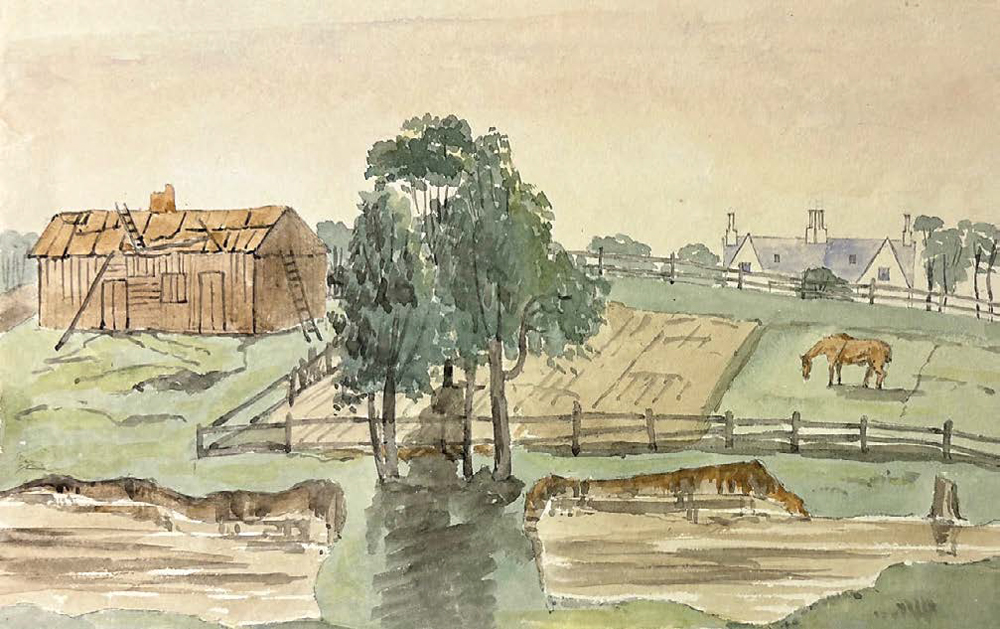
2. James Coutts Crawford (1817–1889), Lyndhurst. Designed by John Verge for surgeon and hospital inspector James Bowman and his wife Mary, the daughter of John and Elizabeth Macarthur, ‘Lyndhurst’ was sited on 36 acres with water frontages and completed in 1837. The house originally had an extensive pair of service wings that this watercolour records. They were demolished as part of subdivisions, leaving a much truncated but still important house. By 1984 it was in total dereliction and under threat of demolition but was saved by the Historic Houses Trust of NSW and used as their base for several years, until it was resold into private ownership. This important watercolour records its marine setting onto Blackwattle Bay and the original topography.
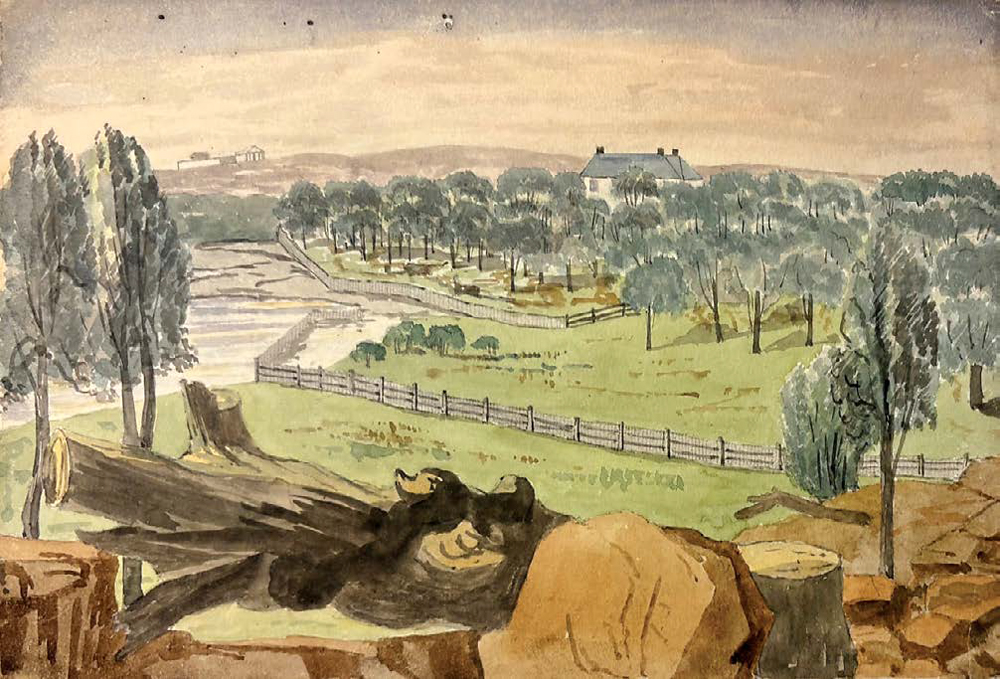
3. James Coutts Crawford (1817–1889), The Gothic Cottages. Also known as ‘The Swiss Cottages’, ‘The Gothic Cottages’ were built in 1842 in picturesque rustic style, featuring elaborate gabled fronts and bay windows. Unfortunately, one half of the two attached houses was demolished in the 1970s for a motel development. The remaining half is in less than ideal condition and is hidden behind a row of 1920s shops. This picture is important as the track in the foreground is now a busy road. This is the earliest known picture of the houses.